

 United Kingdom (UK)
 United States (US)
 Canada
 South Africa
 India
 Australia
 New Zealand
 China
 Russia
 Germany
 France
 Spain
 Netherlands
 Vietnam
 United Arab Emirates
 Italy
 Poland
 Thailand
 Türkiye









 Algeria


Updated 8 October 2026: job search, application and scam-check guidance re-checked.
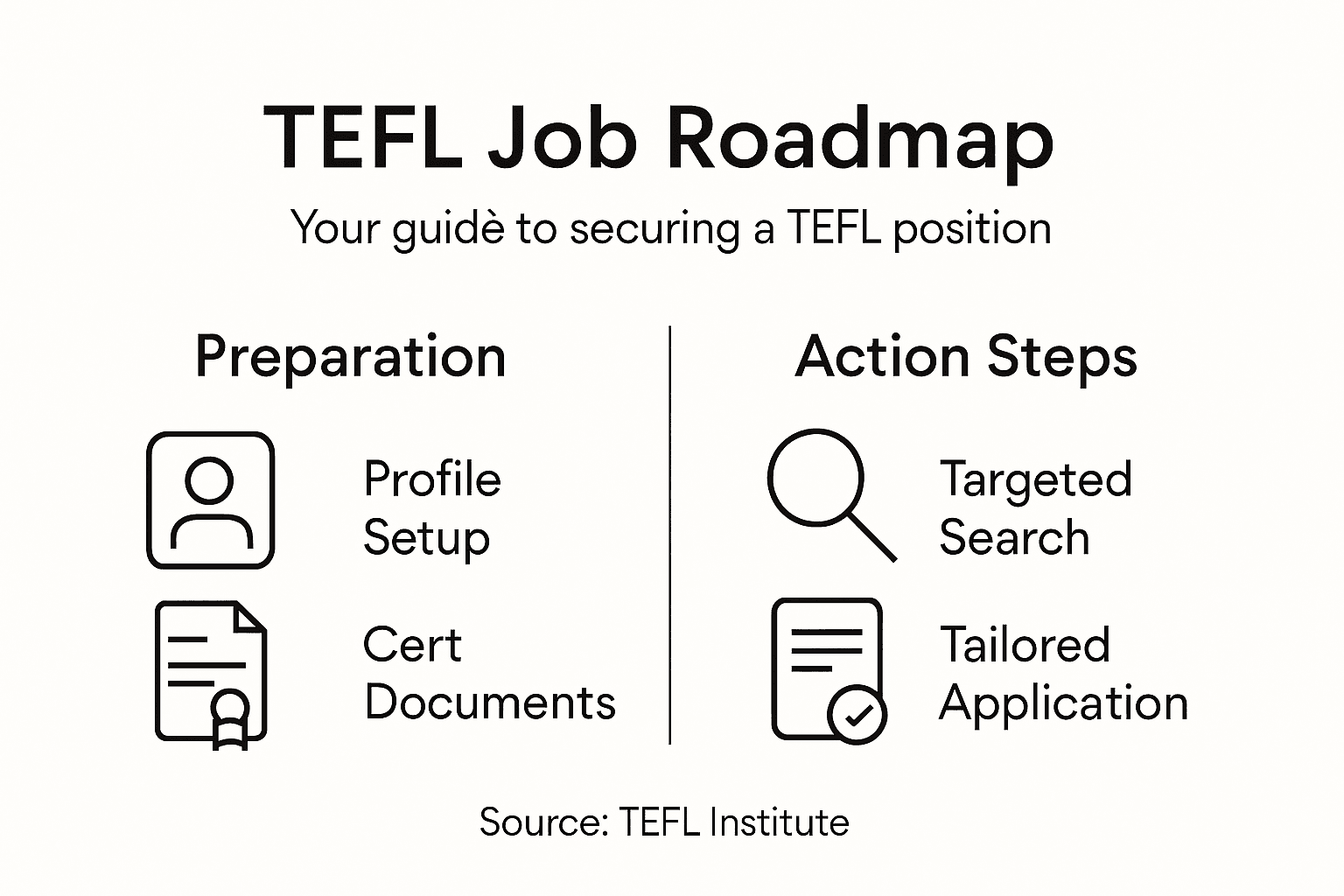
To get your first TEFL job, use two or three specialist job boards rather than ten, apply only to roles whose visa and degree rules you meet, tailor each application, and verify the school before you sign. Most hires happen after a video interview and a short demo lesson, so prepare one before you start applying.

TEFL job boards are crowded, and new teachers often respond by applying everywhere. That usually backfires: generic applications get ignored, and some listings are not what they seem. This guide shows where to look, how to apply so schools reply, and how to check a job is genuine.
Key takeaways
- Pick a target country first; it decides which boards and which roles are worth your time.
- Specialist TEFL boards beat general job sites for first jobs abroad.
- Apply only where you meet the visa and degree rules. Schools cannot change immigration law.
- Prepare a demo lesson before you apply; it is the step most first timers fail.
- Never pay an employer to get a job, and never travel without a written contract.
Where should you look for your first TEFL job?
Start with established TEFL job boards, add one regional source for your target country, and use recruiters only where they are paid by the school rather than by you.
| Source | Best for | Watch for |
|---|---|---|
| Specialist TEFL job boards (for example Dave’s ESL Cafe, Teach Away) | Language schools and programmes worldwide | Duplicate and expired listings |
| Government programmes (EPIK, JET and others) | Structured public school roles with visa support | Fixed annual application windows |
| School websites and chains | Direct applications to known employers | Slower replies |
| Recruiters | Help with placement and paperwork in Asia and the Gulf | Any fee charged to the teacher |
| Online teaching platforms | Remote work while you build experience | Variable hours and pay |
For live roles we have checked, see our TEFL jobs board, and for deadlines and hiring news, The Hire Wire.
How do you apply so schools actually reply?
Tailor every application to the advert, show your TEFL hours and degree in the first lines of your CV, and answer exactly what the school asks for. Directors of Studies skim dozens of applications; make the essentials impossible to miss.

- CV: qualifications first, then any teaching, tutoring or coaching experience. Our guide to writing a TEFL CV has a template.
- Cover note: three or four sentences naming the school, the role and why you fit.
- Photo and video: many Asian schools expect a professional photo; a short introduction video helps online applications.
- Eligibility: state your nationality, degree and availability clearly so the school does not have to ask.
How to Land Your First TEFL Job
How should you prepare for the interview and demo lesson?
Expect a video interview followed by a five to fifteen minute demo lesson. Plan one short lesson you can adapt to any level, with a clear aim, a warm up, controlled practice and a freer speaking task.
Every TEFL opening, salary and deadline that matters.
In your inbox every two weeks. Free, no spam, unsubscribe any time.
Teacher pay by country
New TEFL openings
Programme and visa dates
Our guide to passing a TEFL job interview covers the seven most common questions and a ready made demo lesson framework.
How should you evaluate a TEFL job offer?
Compare offers on the full package, not the headline salary. Housing, flights, teaching hours and visa support can matter more than a small difference in pay.
| What to compare | Questions to ask |
|---|---|
| Pay and benefits | What is the monthly salary? Is housing provided or paid? Are flights reimbursed? |
| Workload | How many teaching hours a week? How many office hours? What class sizes? |
| Visa | Which visa, and who pays for and handles it? |
| Support | Is there training, a mentor or a Director of Studies? |
| Contract | Length, holidays, sick pay, end of contract bonus and notice terms |
For realistic pay by country, check the TEFL Salary Index.
How do you spot a fake or risky TEFL job?
The clearest warning sign is any request for money from the employer before you start. Legitimate schools do not charge teachers to be hired.
- Upfront fees for “processing”, “training” or “visa” paid to the school or an unknown agent.
- No written contract, or one that does not match what you were told.
- Working on a tourist entry rather than a proper work visa.
- No contact with current teachers when you ask for it.
- Pay that is far above the local going rate with no clear reason.
Before you travel, check your government’s advice for the country, such as UK FCDO travel advice.
Ready to start applying?
The TEFL Institute Group is Europe’s largest TEFL trainer by teachers certified, with 161,000 teachers certified since 2017 and graduates in 80 countries.
Start with the 120 Hour Advanced TEFL Course for most first jobs, or the 180 Hour Level 5 TEFL Diploma (Ofqual 610/1571/4) to stand out in competitive markets.

Jessica Jeffery, Recruitment and Partnerships Specialist
Holds a business degree plus TEFL and CELTA, and taught in Thailand and Italy; helps students find high quality jobs and internships.

Tara and Jess talk through different TEFL and EFL topics, from finding work abroad to life in the classroom.
FAQs
Questions students ask us
Start with two or three established TEFL job boards, such as Dave’s ESL Cafe or Teach Away, plus one regional source for your target country. Government programmes like EPIK and JET, school websites and recruiters paid by the school are also good routes. Focused searching beats applying everywhere.
Lead your CV with your TEFL qualification and degree, include any tutoring, coaching or volunteering, and apply only to roles whose visa rules you meet. Prepare a short demo lesson before applying, because most schools hire after a video interview and a demo, and that is where first timers most often struggle.
Many teachers receive offers within a few weeks of applying once their documents are ready, but the full process to starting work, including visa processing and document legalisation, often takes two to four months. Government programmes run on fixed annual timelines, so check their application windows early.
Be wary of any request for money from the employer before you start, no written contract, roles that expect you to work on a tourist entry, refusal to put you in touch with current teachers, and pay far above the local going rate. Legitimate schools do not charge teachers to be hired.
Compare the full package rather than the headline salary: housing, flight reimbursement, teaching and office hours, class sizes, visa support, training, holidays, sick pay and contract length. Ask for everything in writing and compare offers against dated pay data for the country.
A recruiter can help, especially in Asia and the Gulf where paperwork is complex. Reputable recruiters are paid by the school, not the teacher. If a recruiter asks you for a placement fee, look for another route or check carefully what the fee covers before agreeing.
